
01
The Impact
Quantitative Impact
87%
higher immersion vs traditional climate games (p<0.001)
higher immersion vs traditional climate games (p<0.001)
84%
better guidance scores through cultural mentorship
85%
higher accomplishment from ritual-based interactions
84%
better guidance scores through cultural mentorship
85%
higher accomplishment from ritual-based interactions
Behavioral Transformation
Participants reframed climate action as "sacred duty" rather than civic obligation
Participants reframed climate action as "sacred duty" rather than civic obligation
3x higher motivation for culturally-specific actions vs. generic environmental advice
Users reported feeling "seen as a community" through authentic representation
3x higher motivation for culturally-specific actions vs. generic environmental advice
Users reported feeling "seen as a community" through authentic representation
Real-World Adoption
DIS 2025 publication with Best Paper Award
Used by 5 temples and 2 universities for climate education and game design.
Games for Change Festival featured presentation
DIS 2025 publication with Best Paper Award
Used by 5 temples and 2 universities for climate education and game design.
Games for Change Festival featured presentation
Behavioral Transformation
Participants reframed climate action as "sacred duty" rather than civic obligation
3x higher motivation for culturally-specific actions vs. generic environmental advice
Users reported feeling "seen as a community" through authentic representation
Real-World Adoption
DIS 2025 publication with Best Paper Award
Used by 5 temples and 2 universities for climate education and game design.
Games for Change Festival featured presentation
02
The Problem
1.2 billion Hindus face severe climate impacts, yet after analyzing 41 climate games, We found zero spoke their cultural language. Every solution used generic "save the polar bears" messaging that ignores the religious frameworks that actually motivate this community.
1.2 billion Hindus face severe climate impacts, yet after analyzing 41 climate games, We found zero spoke their cultural language. Every solution used generic "save the polar bears" messaging that ignores the religious frameworks that actually motivate this community.
1.2 billion Hindus face severe climate impacts, yet after analyzing 41 climate games, We found zero spoke their cultural language. Every solution used generic "save the polar bears" messaging that ignores the religious frameworks that actually motivate this community.
03
Research Strategy
RQ1: Learning & Motivation
How does the integration of religious rituals and narratives in a serious game enhance players' reflection and interest in climate change?
RQ1: Learning & Motivation
How does the integration of religious rituals and narratives in a serious game enhance players' reflection and interest in climate change?
RQ2: User Experience
How does the integration of religious rituals and narratives in a serious game influence engagement and player experience?
RQ2: User Experience
How does the integration of religious rituals and narratives in a serious game influence engagement and player experience?
Rather than applying cultural themes superficially, I embedded authentic Hindu rituals into core game mechanics through deep ethnographic research and community collaboration.
Rather than applying cultural themes superficially, I embedded authentic Hindu rituals into core game mechanics through deep ethnographic research and community collaboration.
Rather than applying cultural themes superficially, I embedded authentic Hindu rituals into core game mechanics through deep ethnographic research and community collaboration.
Phase- 1: Deep Ethnographic Discovery
Conducted immersive fieldwork at two of India's largest pilgrimage sites during active climate impacts:
Conducted immersive fieldwork at two of India's largest pilgrimage sites during active climate impacts:
Conducted immersive fieldwork at two of India's largest pilgrimage sites during active climate impacts:
Tirumala & Sabarimala: 50,000+ daily visitors in climate-vulnerable mountain regions
412 photos, 43 videos documenting how climate change disrupts sacred practices
Grounded theory analysis revealing the spiritual dimensions of environmental crisis
Tirumala & Sabarimala: 50,000+ daily visitors in climate-vulnerable mountain regions
412 photos, 43 videos documenting how climate change disrupts sacred practices
Grounded theory analysis revealing the spiritual dimensions of environmental crisis
Tirumala & Sabarimala: 50,000+ daily visitors in climate-vulnerable mountain regions
412 photos, 43 videos documenting how climate change disrupts sacred practices
Grounded theory analysis revealing the spiritual dimensions of environmental crisis

Climate Elements, and Climate Efforts being noted at different religious sites.
Climate Elements, and Climate Efforts being noted at different religious sites.
Key Insight: Climate change isn't just an environmental problem for Hindu communities—it's a spiritual crisis that prevents religious fulfillment.
Critical field observation: "I watched families who had traveled hundreds of miles break down when climate-induced rains closed pilgrimage routes. This wasn't disappointment—it was profound spiritual distress at being unable to complete religious obligations."
Key Insight: Climate change isn't just an environmental problem for Hindu communities—it's a spiritual crisis that prevents religious fulfillment.
Critical field observation: "I watched families who had traveled hundreds of miles break down when climate-induced rains closed pilgrimage routes. This wasn't disappointment—it was profound spiritual distress at being unable to complete religious obligations."
Key Insight: Climate change isn't just an environmental problem for Hindu communities—it's a spiritual crisis that prevents religious fulfillment.
Critical field observation: "I watched families who had traveled hundreds of miles break down when climate-induced rains closed pilgrimage routes. This wasn't disappointment—it was proiulfound spiritual distress at being unable to complete religious obligations."
Phase - 2 : Respectful Co-Design Process
Critical Learning Moment: My initial prototype allowing players to control Hindu deities was immediately rejected by religious scholars: "Gods don't 'level up'—they're omnipotent."
Solution: Redesigned the experience where players embody "Shloka"—a chosen individual receiving guidance from climate deities through authentic ritual practice.
Critical Learning Moment: My initial prototype allowing players to control Hindu deities was immediately rejected by religious scholars: "Gods don't 'level up'—they're omnipotent."
Solution: Redesigned the experience where players embody "Shloka"—a chosen individual receiving guidance from climate deities through authentic ritual practice.
Critical Learning Moment: My initial prototype allowing players to control Hindu deities was immediately rejected by religious scholars: "Gods don't 'level up'—they're omnipotent."
Solution: Redesigned the experience where players embody "Shloka"—a chosen individual receiving guidance from climate deities through authentic ritual practice.

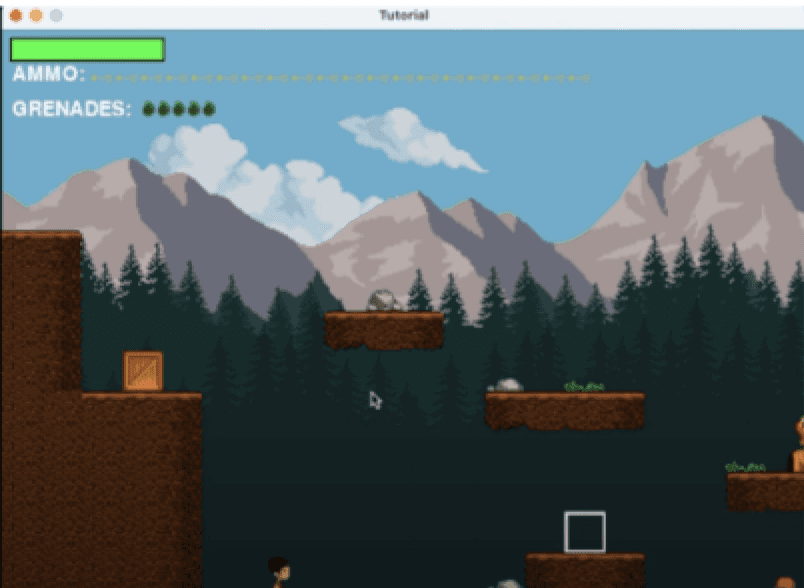
(a) First Drafts:
Early prototypes used gods and rituals to combat climate harm. Later, Shloka used rituals to gain power.

(b) Stakeholder Feedback:
Cultural advisors flagged religious sensitivity concerns and guided climate representation.
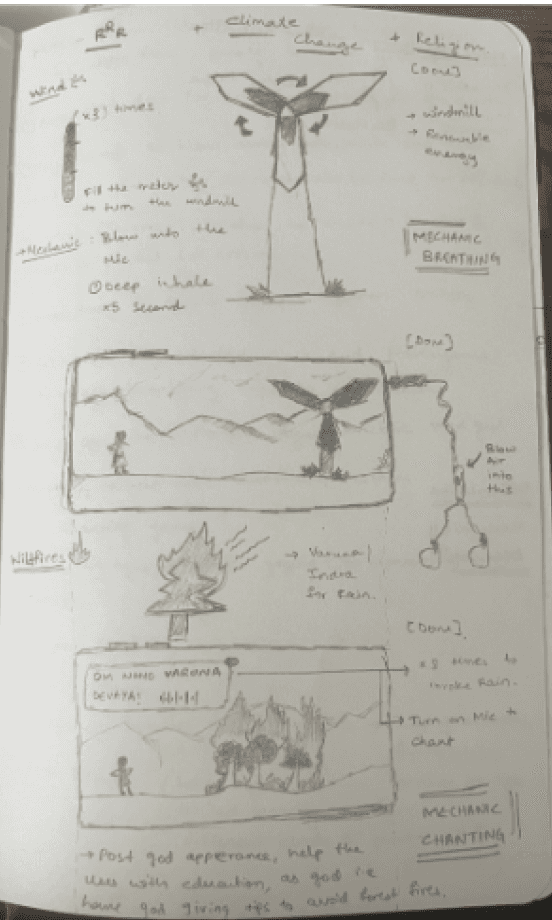
(C) Iterative steps:Incorporated feedback to remove actual gods, focus on non-violence, and shift to message-driven gameplay.
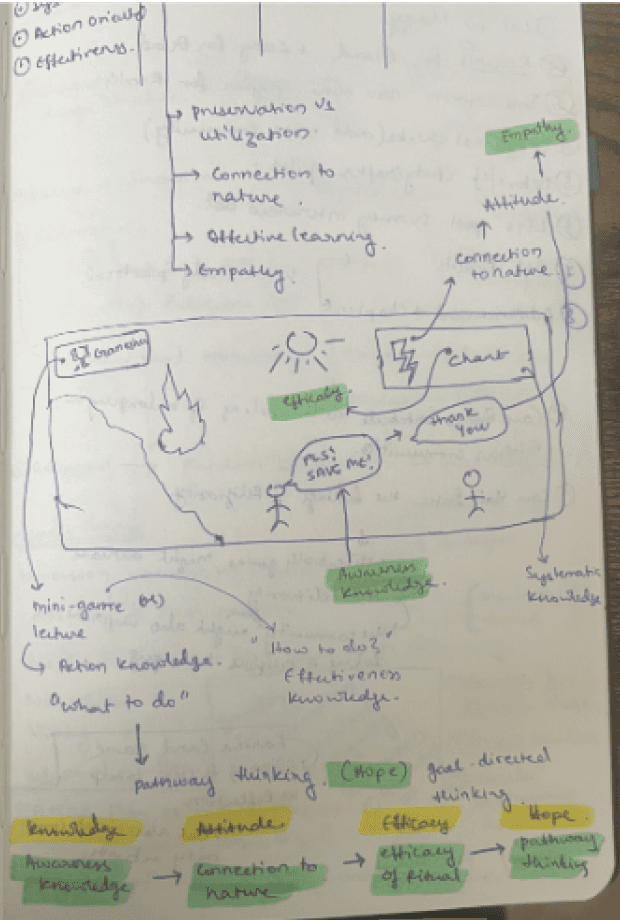
Incorporating IGDA climate change framework with religious elements.
Discussing with stakeholders, and iterative process taken during the development of Shloka.
Technical Innovation: Successfully digitized 7 sacred rituals while preserving spiritual authenticity:
Technical Innovation: Successfully digitized 7 sacred rituals while preserving spiritual authenticity:
Mudra recognition: 92% accuracy using computer vision
Chanting validation: Sanskrit pronunciation with cultural expert oversight
Breathing analysis: Traditional Pranayama meditation techniques
Mudra recognition: 92% accuracy using computer vision
Chanting validation: Sanskrit pronunciation with cultural expert oversight
Breathing analysis: Traditional Pranayama meditation techniques
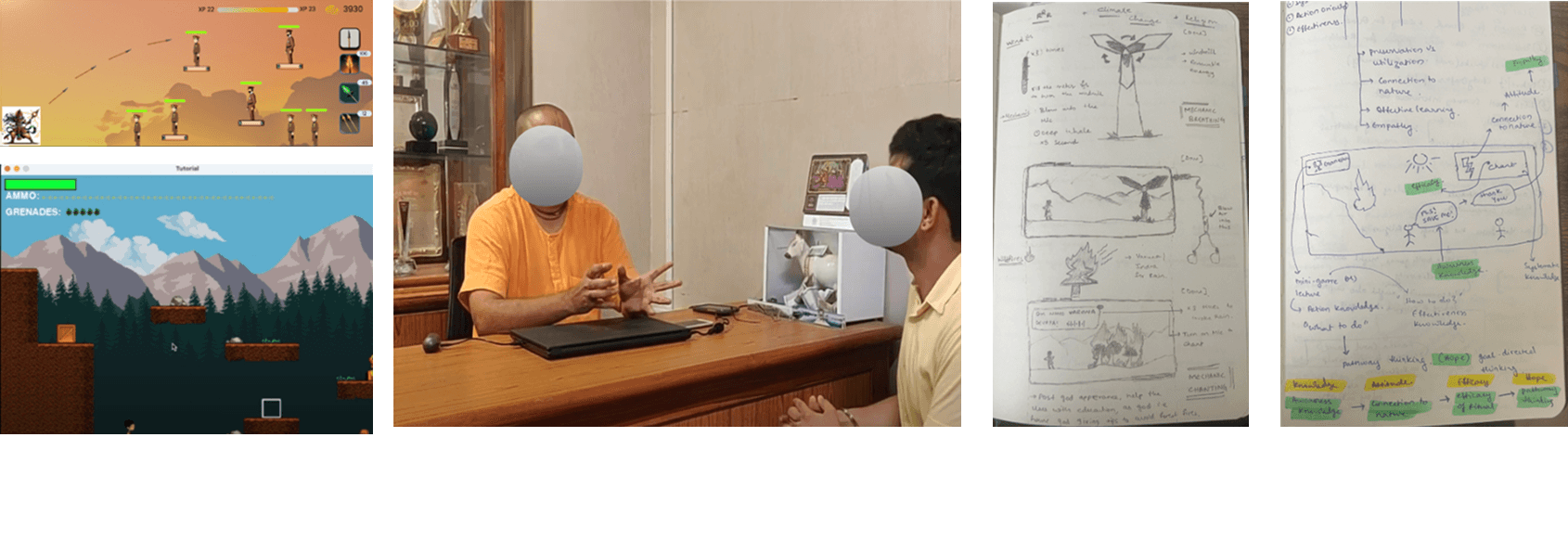
Framework Development: The IGDA Climate Integration
To ensure educational effectiveness, I adapted the IGDA Climate Special Interest Group's framework for climate game design, creating a structure that honored both learning science and Hindu philosophical traditions:
To ensure educational effectiveness, I adapted the IGDA Climate Special Interest Group's framework for climate game design, creating a structure that honored both learning science and Hindu philosophical traditions:
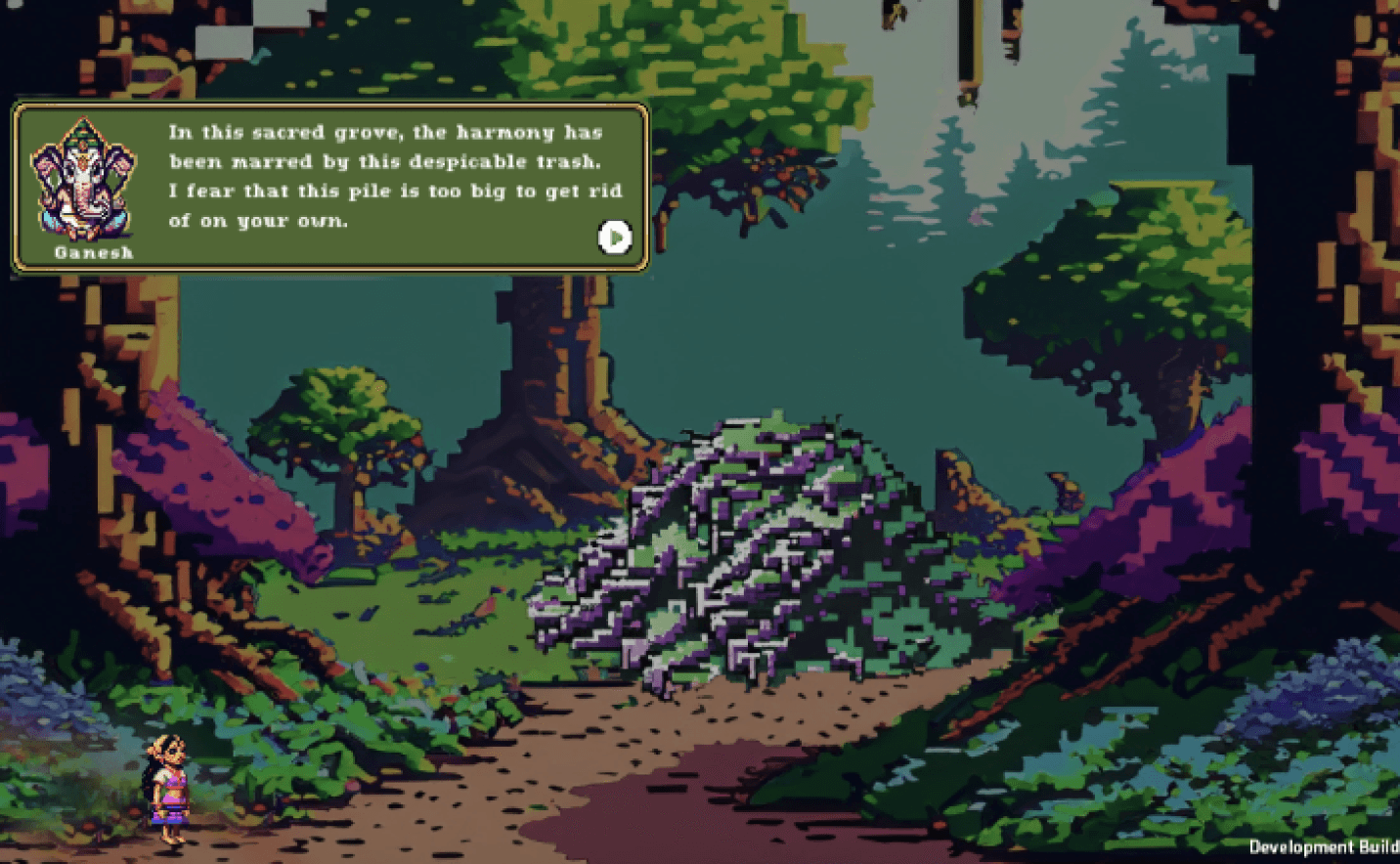
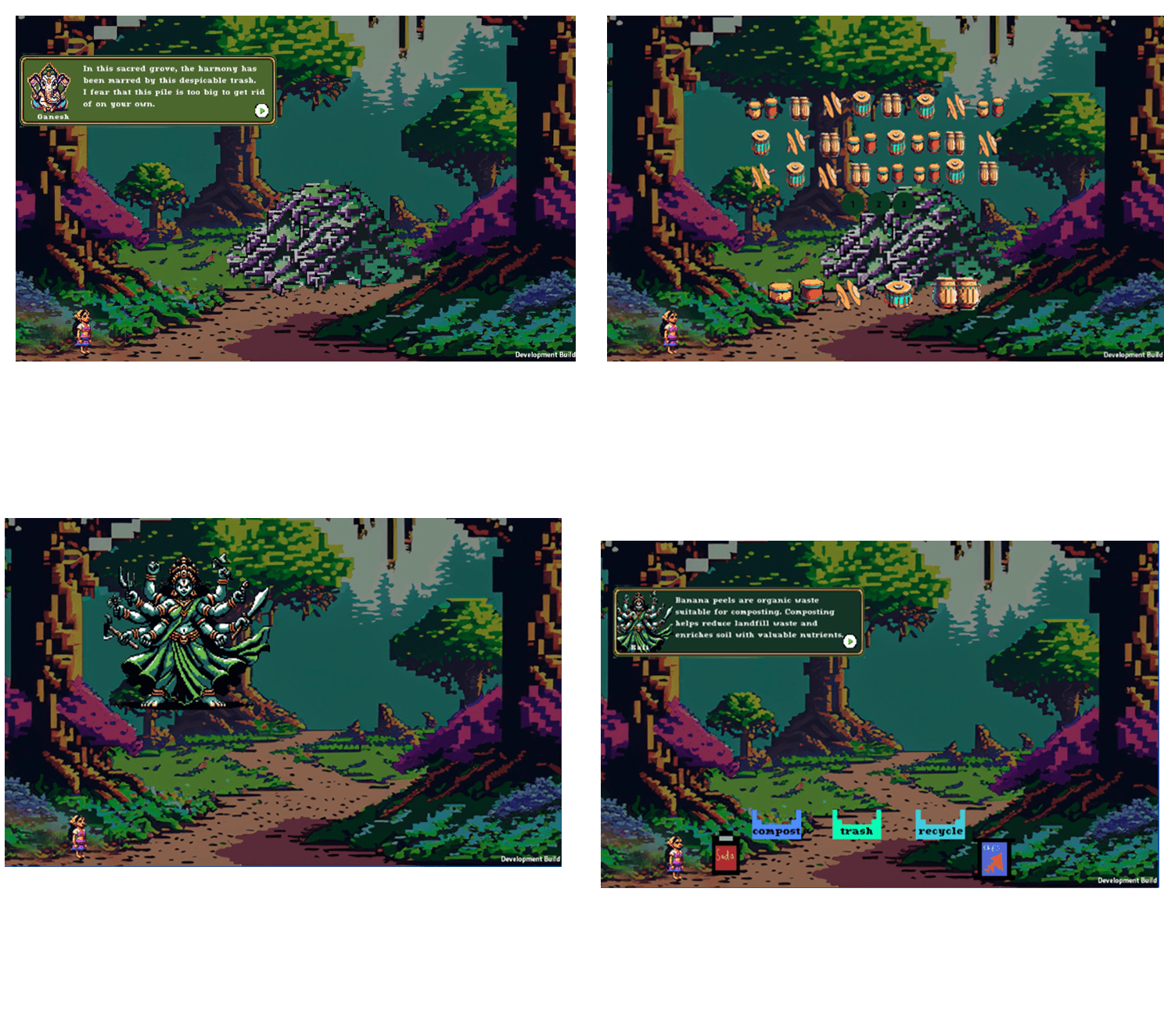
Knowledge Stage (Level 2):
The IGDA framework recommends this step to provide players essential knowledge about climate change and its impacts. In this level, Ganesha teaches the player about how increasing devotees are polluting the holy forests, which in turn disturbs wildlife, eco-systems.
Knowledge Stage (Level 2):
The IGDA framework recommends this step to provide players essential knowledge about climate change and its impacts. In this level, Ganesha teaches the player about how increasing devotees are polluting the holy forests, which in turn disturbs wildlife, eco-systems.
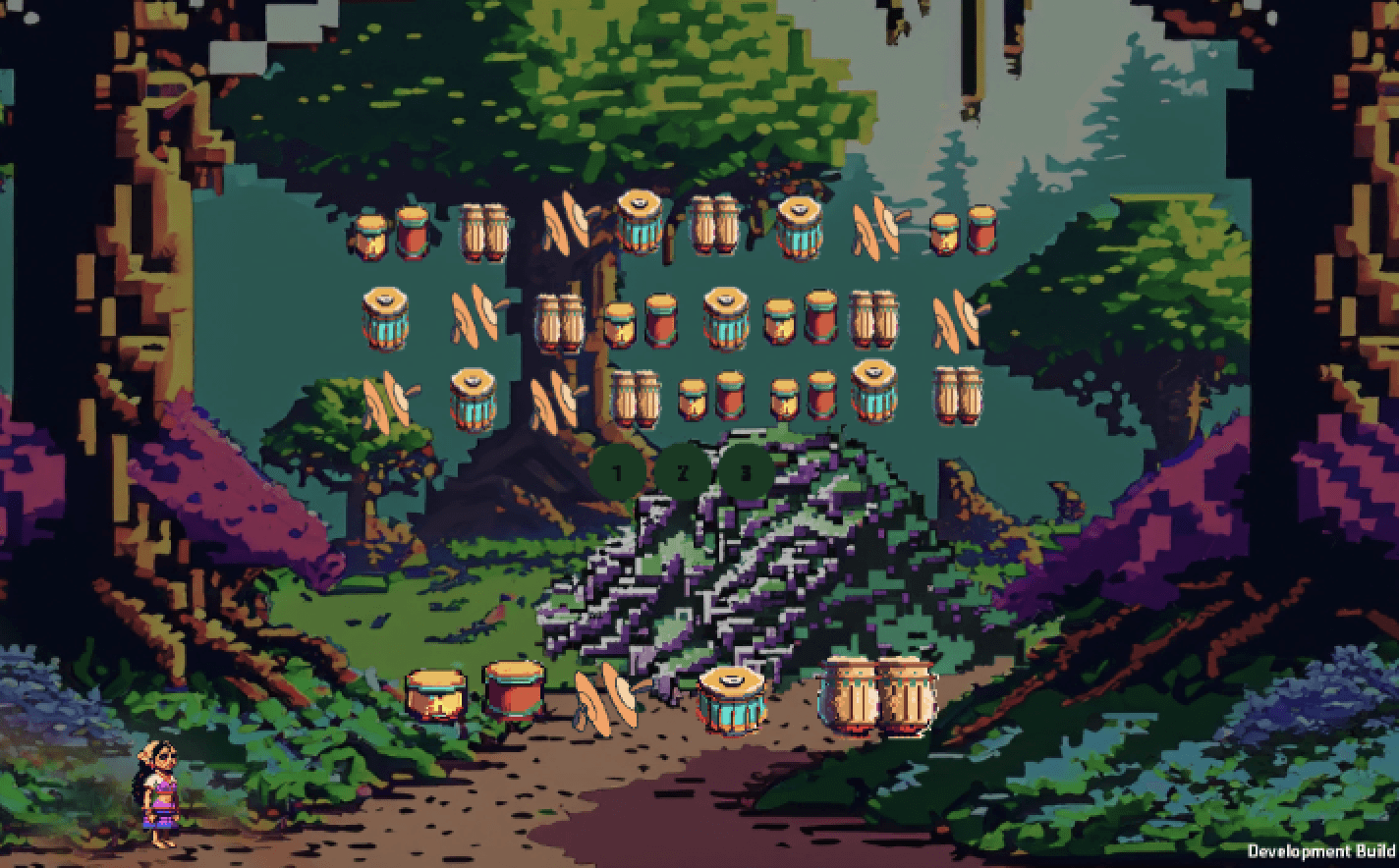
Attitude Stage (Level 2):
The IGDA framework recommends this step to provide players a connection with nature. In this level, the path of Shloka is blocked and cannot continue in her pilgrimage due to increasing landfills and un-recycled trash. The player develops a connection with a climate change god by performing a ritual.
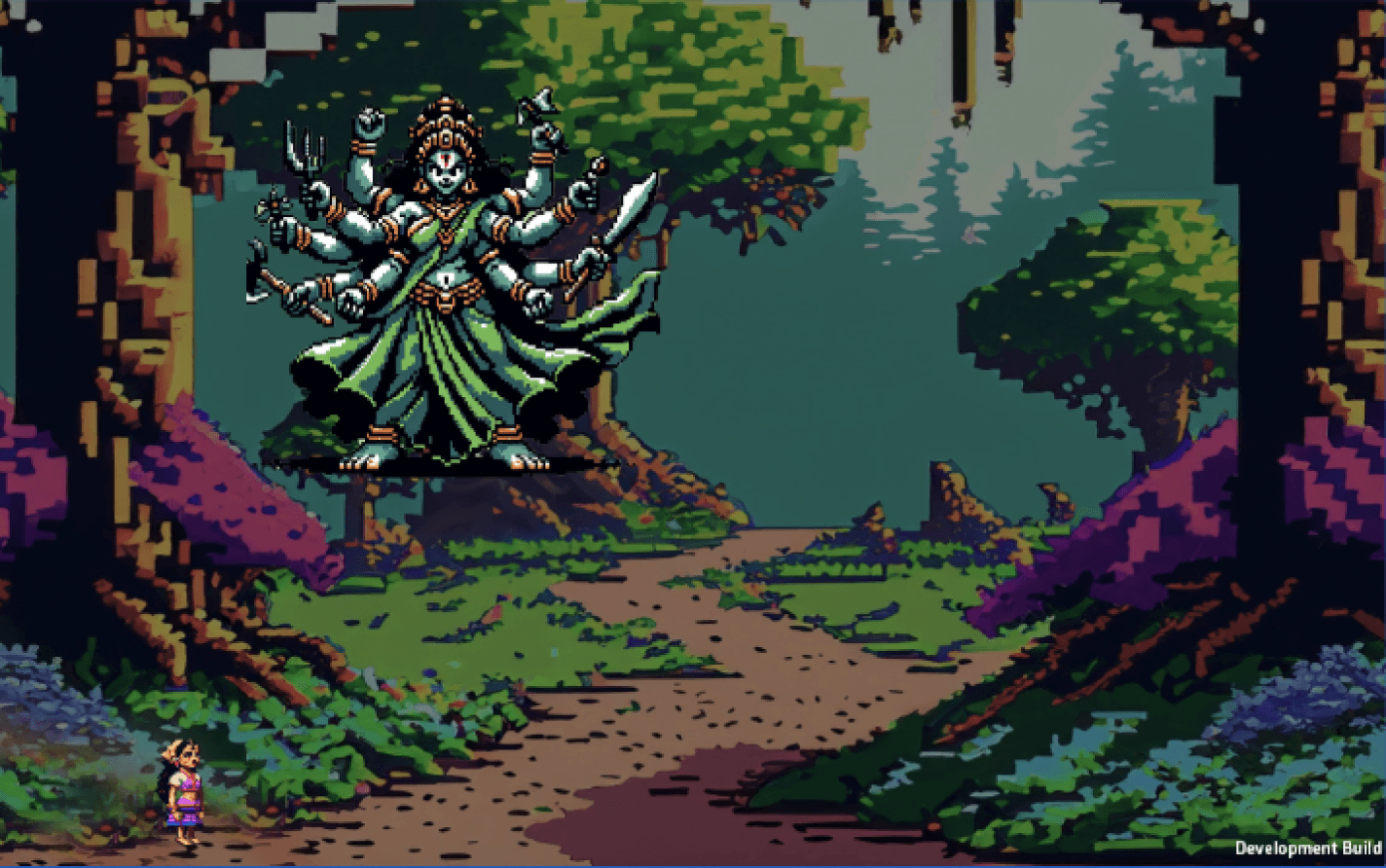
Efficacy Stage (Level 2):
The IGDA climate change framework recommends this step to provide agency to players to impact climate action. In this level, the ritual invokes the goddess Kali and provides the player with the power “multiple-hands”. The player here is tasked to quickly sort the trash pile, using the multiple hands as a power gained. (See how the trash pile blocking on the road is gone, as the player has sorted it during gameplay)
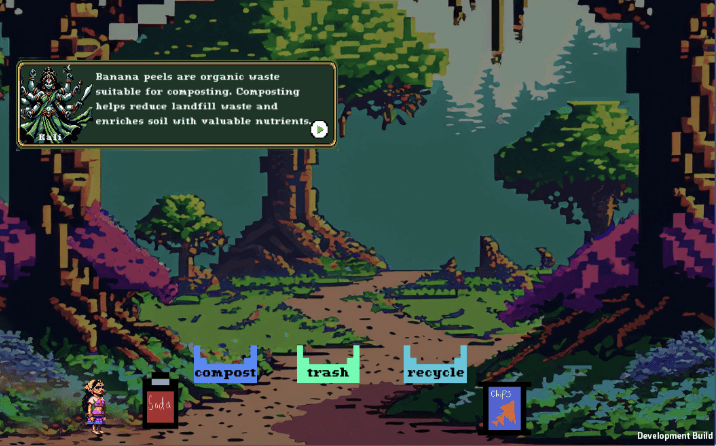
Hope Stage (Level 2):
The IGDA climate change framework recommends this step to provide future pathway thinking for positive climate action. In this level, the player is educated how trash often found in temple complexes can be categorized effectively and keep the holy forests safe.
Different stages in a level in the game Shloka. Each level indicating a specific objective to teach climate change.
Phase- 3: Rigorous Evaluation & Validation
Comparative Study: Shloka vs. 10 existing climate games with 24 practicing Hindu participants
3-hour sessions with randomized game order and validated measurement instruments
Statistical analysis using appropriate non-parametric tests with multiple comparison corrections
Comparative Study: Shloka vs. 10 existing climate games with 24 practicing Hindu participants
3-hour sessions with randomized game order and validated measurement instruments
Statistical analysis using appropriate non-parametric tests with multiple comparison corrections
Design Principles That Drive Results
Through this research, I identified five principles for culturally-responsive UX that are now being applied beyond gaming:
Authentic Practice > Visual Themes
Finding: Cultural aesthetics don't drive engagement—embedding actual cultural practices into interactions does.
Finding: Cultural aesthetics don't drive engagement—embedding actual cultural practices into interactions does.
Evidence: 87% higher immersion vs. games with cultural visuals but Western mechanics.
Evidence: 87% higher immersion vs. games with cultural visuals but Western mechanics.
Existing Values > New Frameworks
Finding: Connect desired behaviors to users' existing moral systems rather than creating new value structures.
Finding: Connect desired behaviors to users' existing moral systems rather than creating new value structures.
Evidence: Participants naturally reframed environmental action using existing religious concepts.
Evidence: Participants naturally reframed environmental action using existing religious concepts.
Personal Relevance > Global Abstractions
Finding: Local, personally meaningful consequences motivate more than distant global impacts.
Evidence: 82% higher relatedness scores for threats to familiar temples vs. polar ice statistics.
Embodied Interaction > Cognitive Tasks
Finding: Physical ritual performance creates deeper engagement than purely mental activities.
Evidence: Ritual completion + learning goals created "dual achievement" experience.
Cultural Mentorship > System Instruction
Finding: Guidance from culturally-respected figures feels more supportive than neutral tutorials.
Evidence: 84% better guidance scores when deities provided wisdom vs. system prompts.
Personal Relevance > Global Abstractions
Finding: Local, personally meaningful consequences motivate more than distant global impacts.
Evidence: 82% higher relatedness scores for threats to familiar temples vs. polar ice statistics.
Embodied Interaction > Cognitive Tasks
Finding: Physical ritual performance creates deeper engagement than purely mental activities.
Evidence: Ritual completion + learning goals created "dual achievement" experience.
Cultural Mentorship > System Instruction
Finding: Guidance from culturally-respected figures feels more supportive than neutral tutorials.
Evidence: 84% better guidance scores when deities provided wisdom vs. system prompts.
04
Academic Contribution: Framework now cited in subsequent cultural design research and taught in university curricula
Industry Validation: Our Team was Invited to present at 3 universities on culturally-responsive UX methods
Community Benefit: Open-source release enables global adaptation for other cultural contexts
Market Proof: Demonstrated engagement improvements for 1.2B previously underserved users
05
Personal Reflection
This project taught me that authentic representation requires deep cultural understanding, not just inclusive imagery. The most impactful moment came when religious scholars rejected my initial design—forcing me to move from cultural appropriation toward genuine collaboration.
The 87% engagement improvement wasn't just a statistical victory; it proved that when we truly honor users' identities and values, we don't just make better products—we create experiences that feel personally meaningful.
Key Learning: Cultural authenticity isn't just ethically important—it's a competitive advantage that drives measurable user engagement.
This project taught me that authentic representation requires deep cultural understanding, not just inclusive imagery. The most impactful moment came when religious scholars rejected my initial design—forcing me to move from cultural appropriation toward genuine collaboration.
The 87% engagement improvement wasn't just a statistical victory; it proved that when we truly honor users' identities and values, we don't just make better products—we create experiences that feel personally meaningful.
Key Learning: Cultural authenticity isn't just ethically important—it's a competitive advantage that drives measurable user engagement.
06
Skills Demonstrated
Research Methods: Ethnographic fieldwork, mixed-methods analysis, statistical hypothesis testing, cross-cultural research ethics
Design Strategy: Culturally-responsive design frameworks, participatory co-design, serious game mechanics, technical innovation with cultural sensitivity
Impact Creation: Academic publication, real-world implementation, scalable framework development, community partnership
Research Methods: Ethnographic fieldwork, mixed-methods analysis, statistical hypothesis testing, cross-cultural research ethics
Design Strategy: Culturally-responsive design frameworks, participatory co-design, serious game mechanics, technical innovation with cultural sensitivity
Impact Creation: Academic publication, real-world implementation, scalable framework development, community partnership

Links
Shloka:
Pary for Green Play for Green
07